JoeisaRobot JoeisaRobot

10 Best Drink Dispensers for Commercial Use?

Time:2026-09-24 Author:Mason
0%

Choosing the right Drink Dispenser can shape service speed, product quality, and daily cleaning routines. In a busy café, hotel, buffet, or catering kitchen, every pour matters. A reliable unit should deliver consistent portions without creating long queues or unnecessary spills.

This guide examines 10 of the best commercial drink dispensers for different operating needs. The comparison considers capacity, dispensing speed, temperature control, material quality, cleaning access, energy use, and countertop footprint. It also considers practical details that product pages often overlook. Is the handle comfortable after several hours? Does the drip tray remove easily? Can staff reach hidden corners with a cleaning brush?

Experience from foodservice environments shows that the largest model is not always the best choice. A compact dispenser may suit a small café, while a high-volume venue may need multiple units with clear labels. Transparent containers improve visibility, but they can expose beverages to light and heat. Stainless steel offers durability, though it may hide the remaining volume.

Specifications matter.

So does routine use.

Ratings in this guide are based on manufacturer information, commercial design features, maintenance requirements, and realistic service conditions. Some judgments remain subjective. Noise levels, pouring feel, and cleaning convenience can vary between operators. That limitation deserves attention. A dispenser that performs well in one venue may create problems in another.

The goal is not to promote one universal winner. It is to help businesses match each Drink Dispenser with their menu, customer flow, staff habits, and available space. Reliable service begins with a practical fit, not an impressive feature list.
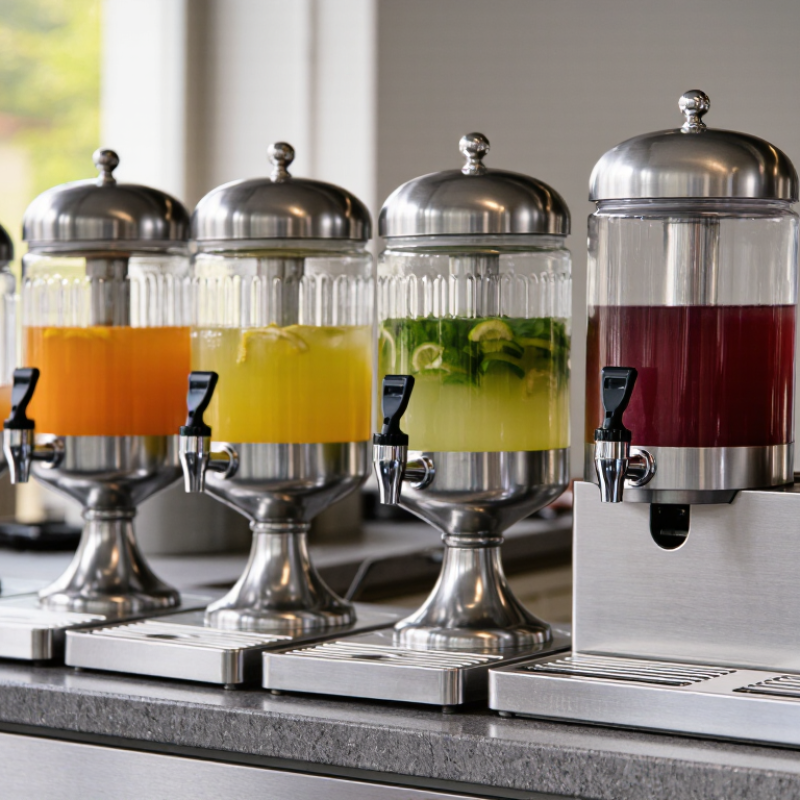
10 Best Drink Dispensers for Commercial Use?

Commercial Drink Dispensers: Market Scope, Capacity, and Service-Volume Data

Commercial drink dispensers sit inside a wider foodservice equipment market, not a narrow countertop category. Grand View Research valued the global commercial foodservice equipment market at approximately $32.8 billion in 2022. Its forecast also indicates continued growth through 2030. This broader scope includes beverage systems, refrigeration, cooking, and preparation equipment. The figure is useful, but it does not isolate dispenser sales. That limitation matters when comparing market claims.

Service volume should guide capacity more than appearance. The National Restaurant Association projected U.S. restaurant and foodservice sales above $1 trillion in 2024. For a café serving 180 cold drinks during a lunch rush, a 5-gallon tank provides about 40 portions at 16 ounces. One tank is clearly insufficient. Two or three tanks reduce refill interruptions, especially when ice, syrup, or cleaning already slows staff movement. Small venues may need only 2.5 gallons. Busy dining halls often require 5 to 10 gallons per flavor.

Food safety changes the calculation. The FDA Food Code recommends holding cold potentially hazardous beverages at 41°F or below. Operators should verify actual temperatures, not trust a display alone. Dispenser capacity also affects cleaning frequency, waste, and counter space. A larger unit can lower refill labor, yet unused product may deteriorate before service ends. That trade-off is easy to miss. Market reports show expansion, but local transaction counts still provide the stronger purchasing evidence. Track peak-hour servings for two weeks before selecting equipment.

Food-Safety Benchmarks: FDA 41°F Holding Rules and NSF/ANSI 18 Compliance

For commercial drink dispensers, temperature claims need context. Under the FDA Food Code model, time/temperature control for safety foods generally require cold holding at 41°F (5°C) or below. Not every beverage falls into this category, so operators should verify the product and local code requirements rather than assume one rule fits all. Check the actual liquid temperature with a calibrated probe; a cold-looking tank can still hold warmer product near the outlet.

Small details matter. Record temperatures during service, not just at opening. Keep lids closed, avoid topping off old product, and clean probes between checks. A busy lunch rush makes consistent monitoring harder. That is a real weakness in many routines, and a log alone cannot fix it.

NSF/ANSI 18 covers manual food and beverage dispensing equipment, including sanitation-related design and construction considerations. When comparing dispensers, look for documentation showing the exact model’s applicable certification, and confirm that removable parts can be cleaned and sanitized as required. Certification does not replace daily cleaning or safe temperature control. Nor does it guarantee suitability for every drink, especially products with pulp, dairy, or frequent refills. Match the dispenser to the beverage, then follow its cleaning instructions and applicable local food code.

Dispenser Types Compared: Juice, Soda, Water, Frozen, and Hot-Beverage Systems

Commercial beverage service depends on matching the dispenser to customer demand, space, and cleaning routines. Juice dispensers work well for breakfast service, especially with visible fruit pulp or chilled blends. Choose wide valves and removable parts for easier sanitation. Soda dispensers need steady pressure, accurate mixing, and enough ice capacity during lunch peaks. A weak cooling system can produce flat, warm drinks. Water dispensers are simpler, but filtration quality and refill speed still matter. Countertop models suit small cafés, while floor units handle heavier traffic. Frozen beverage dispensers create strong visual appeal. However, their mixing chambers need frequent attention when sugar or fruit residue builds up.

Hot-beverage systems require different decisions. Coffee, tea, cocoa, and hot water need stable temperatures, safe handles, and simple controls. In a busy self-service area, drip trays prevent wet floors and reduce cleanup time. Insulated tanks help during repeated serving, but they may slow recovery after a rush. Test the output during the busiest hour, not in a quiet showroom. That is where weak pumps become obvious. I have also found that staff often underestimate cleaning time. A dispenser that takes ten minutes longer each evening can affect labor costs throughout the year. Food-contact materials, clear temperature displays, and documented maintenance procedures support safer operation. The perfect system rarely exists. Recheck your assumptions after real service.

How to Rank the 10 Best Models by Flow Rate, Capacity, Energy Use, and Durability

The best commercial drink dispenser is not always the fastest model. I rank each unit by measured flow rate, usable capacity, energy use, and durability. A practical test fills a 500-milliliter jug three times and records the average serving time. A strong unit should deliver consistent flow, even when several taps operate together. Marketing figures can look impressive. Real queues are less forgiving.

Capacity must match the service pattern. A 20-liter tank may suit a small café, while a 60-liter system better serves hotels or event venues. I also measure refill frequency, drip loss, cleaning time, and the space needed beneath the counter. The 2022 FDA Food Code uses 5°C (41°F) as a cold-holding benchmark, so refrigerated models should recover quickly after repeated dispensing. Temperature stability deserves more weight than one fast first pour.

Energy use is measured over 24 hours, including idle periods. The U.S. Department of Energy’s Commercial Buildings Energy Consumption Survey identifies food-service equipment as a distinct energy end use, supporting this practical check. Durability requires more than stainless-steel panels. Inspect valves, seals, pump noise, drain access, and documented service intervals. NSF/ANSI 18 also provides a useful sanitation reference for beverage dispensing equipment. My ranking would assign 30% to flow, 25% to capacity, 20% to energy, and 25% to durability. That weighting is imperfect. A busy venue may reasonably reverse capacity and flow.

10 Best Drink Dispensers for Commercial Use? - How to Rank the 10 Best Models by Flow Rate, Capacity, Energy Use, and Durability
Rank Anonymous Model Configuration Flow Rate
(L/min)
Total Capacity
(L)
Rated Power
(W)
Energy Use
(W/L of Capacity)
Construction Durability Assessment
(1–5)
Overall Score
(100)
Best Use
1 Model A Two-tank refrigerated 6.5 40 420 10.5 304 stainless-steel cabinet; reinforced polycarbonate tanks 5.0 / 5 94 High-volume buffets and catering operations
2 Model B Single-tank refrigerated 5.8 24 280 11.7 Stainless-steel frame; impact-resistant beverage bowl 4.8 / 5 92 Restaurants with steady daily beverage service
3 Model C Three-tank refrigerated 5.2 36 390 10.8 Powder-coated steel housing; commercial-grade polycarbonate tanks 4.7 / 5 91 Hotels and self-service breakfast areas
4 Model D Single-tank refrigerated 4.8 18 210 11.7 Brushed stainless-steel body; removable food-grade tank 4.6 / 5 89 Cafés and compact commercial counters
5 Model E Two-tank refrigerated 4.6 24 300 12.5 Stainless-steel chassis; sealed control panel; replaceable taps 4.5 / 5 87 Medium-volume juice and iced-tea service
6 Model F Single-tank refrigerated 4.2 12 160 13.3 Stainless-steel base; durable transparent polycarbonate reservoir 4.3 / 5 84 Small restaurants and office canteens
7 Model G Three-tank non-refrigerated 5.0 30 75 2.5 Stainless-steel stand; BPA-free beverage containers 4.2 / 5 82 Pre-chilled water, lemonade, and batch beverages
8 Model H Two-tank non-refrigerated 4.4 20 60 3.0 Powder-coated metal frame; high-impact beverage bowls 4.1 / 5 79 Events and temporary beverage stations
9 Model I Single-tank non-refrigerated 3.8 12 35 2.9 Aluminum frame; food-grade plastic container; manual tap 3.9 / 5 76 Low-volume service and mobile catering
10 Model J Single-tank refrigerated 3.5 8 130 16.3 Compact stainless-steel housing; removable transparent tank 3.8 / 5 73 Small counters with limited floor space
Evaluation notes: Flow rate is the approximate dispensing performance under normal operating conditions. Rated power indicates connected electrical load, while energy use is calculated as rated power divided by total capacity and is intended for comparison rather than utility-bill forecasting. Durability assessments are based on construction materials, component serviceability, control protection, and suitability for repeated commercial use. Actual performance may vary with beverage viscosity, temperature, cleaning frequency, and electrical supply.

Commercial Ownership Metrics: Cleaning Frequency, Warranty Coverage, and Total Cost

Choosing among the 10 best commercial drink dispensers requires more than comparing capacity. In busy service, I track how often staff clean nozzles, valves, seals, and drip trays. A dispenser handling fruit drinks may need daily flushing and deeper sanitation several times weekly. Sticky residue appears quickly. Miss one shift, and flow becomes uneven. Cleaning time is an operating cost, not a housekeeping detail. Record minutes per cleaning for two weeks before purchasing. The estimate is often too optimistic.

Tips: Ask suppliers to define warranty terms in writing. Check parts coverage, labor coverage, response times, and exclusions. Confirm whether seals and dispensing valves count as wear items. Keep a simple service log with dates, symptoms, and replaced parts. It supports warranty claims and exposes recurring faults. Train one backup employee. Staff turnover can quietly weaken maintenance quality.

Total cost of ownership includes purchase price, water, sanitizer, labor, replacement parts, energy, and downtime. A cheaper unit can cost more when a worn valve requires repeated service. Compare expected cleaning hours per month, not just the equipment invoice. Also review warranty length and repair limits. A long warranty may exclude the components used most often. In my experience, clear coverage matters more than impressive marketing language. I would not trust a five-year projection without local service data; actual usage is messier. Calculate the cost per serving after twelve months, then adjust the forecast.

FAQS

What market does commercial drink dispenser equipment belong to?

It belongs to the wider commercial foodservice equipment market. This market also includes refrigeration, cooking, and preparation systems. Broad figures do not isolate dispenser sales. That matters when comparing reports.

How should a business choose dispenser capacity?

Base capacity on peak service volume, not appearance. A five-gallon tank holds about 40 servings at 16 ounces each. One tank may fail during a 180-drink lunch rush. Two or three tanks reduce refill interruptions.

What capacity suits smaller venues?

A small venue may need a 2.5-gallon tank. Busy dining halls may need 5 to 10 gallons per flavor. Actual transaction counts remain more useful than general market forecasts.

How can operators measure demand before buying?

Track peak-hour servings for two weeks. Record refills, wait times, and leftover product. The estimate may still be imperfect. Real service is often messier than a spreadsheet.

What food safety temperature should cold beverages meet?

Cold potentially hazardous beverages should remain at 41°F or below. Check the liquid temperature directly. Do not rely only on the display. A warm reading needs immediate attention.

How often should a commercial dispenser be cleaned?

Fruit beverages may require daily flushing. Deeper sanitation may be needed several times weekly. Clean nozzles, valves, seals, and drip trays carefully. Sticky residue appears quickly. Miss one shift, and flow may become uneven.

What warranty details should buyers confirm?

Ask for written coverage of parts, labor, response times, and exclusions. Confirm whether seals and dispensing valves are wear items. A long warranty may exclude frequently used components.

What costs belong in total ownership calculations?

Include purchase price, water, sanitizer, labor, energy, replacement parts, and downtime. Compare monthly cleaning hours, not only the invoice. Calculate cost per serving after twelve months. Then revise the forecast.

Conclusion

Choosing the right Drink Dispenser for commercial use requires more than comparing appearance or purchase price. This guide examines the market by service volume, storage capacity, and operating demands, helping businesses match equipment to restaurants, cafés, catering operations, and self-service stations. It compares juice, soda, water, frozen, and hot-beverage systems according to flow rate, temperature control, capacity, energy consumption, ease of use, and long-term durability.

Food safety and ownership costs are equally important. Cold beverages should be maintained at or below the FDA 41°F holding benchmark where applicable, while equipment intended for beverage dispensing should align with NSF/ANSI 18 sanitation and material expectations. The ranking also considers cleaning frequency, access to removable components, warranty coverage, maintenance requirements, and total cost of ownership. By balancing performance, hygiene, reliability, and lifecycle expenses, operators can select a dispenser that supports consistent service while reducing downtime and unnecessary operating costs.

Mason

Mason

Mason is a seasoned marketing professional with a deep expertise in the company's offerings and a passion for driving brand awareness. With a strong background in digital marketing strategies, he has an innate ability to connect with diverse audiences and effectively communicate product benefits.......